Insights > Article > Posted: 2026-Apr-14, Updated: 2026-Apr-15
Why Your Windows Are Sticking: The Truth About Improper Installation
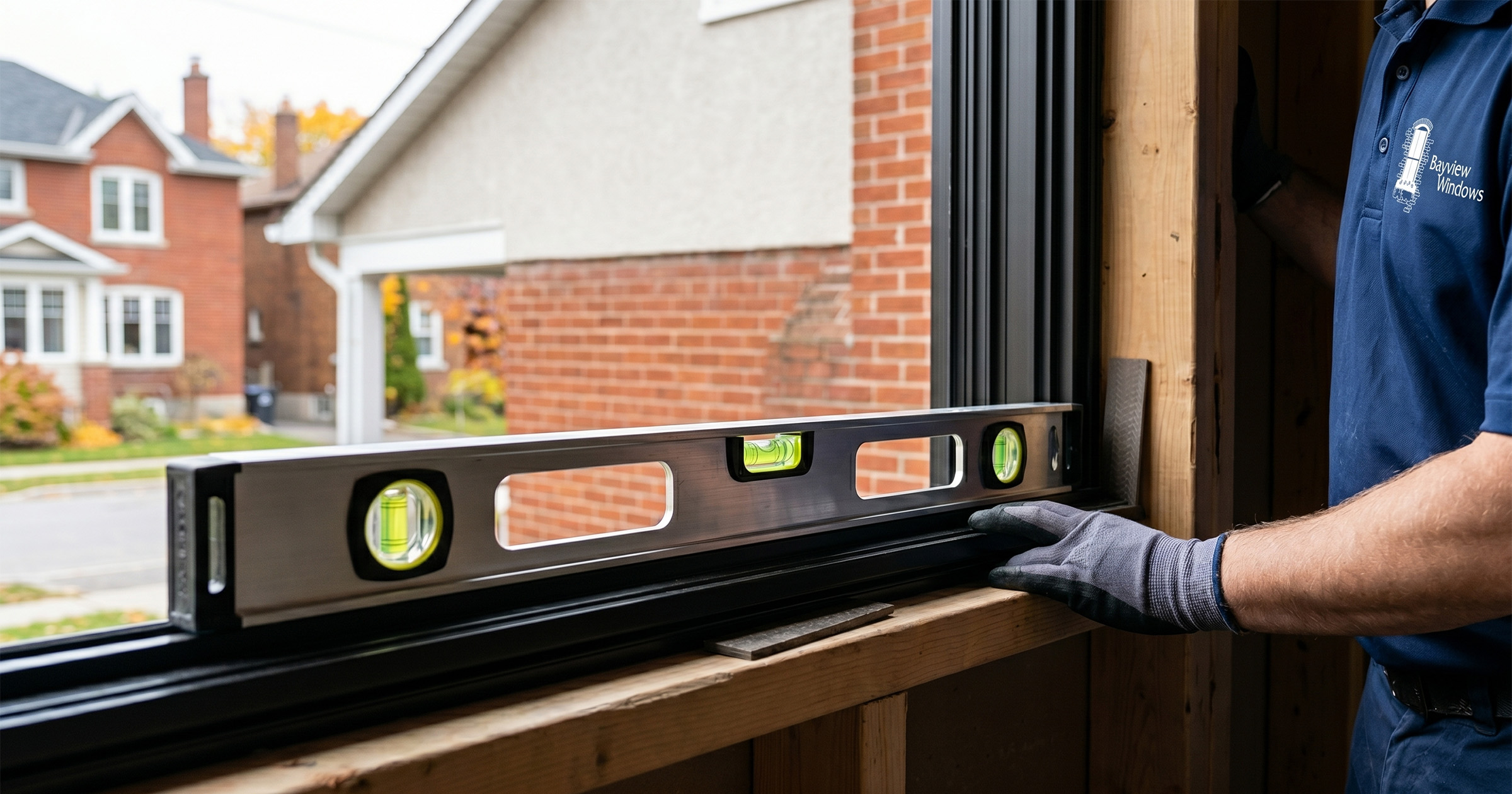
That foundation rests on three words every homeowner should know: Level, Plumb, and True.
In this article:
- The anatomy of a perfect fit
- What happens when it’s done wrong?
- Why shims matter
- The Bayview approach: precision placement
- The Bayview difference: quality over speed
- Related articles
- Request a quote
The anatomy of a perfect fit
In the world of professional installation, "close enough" is an invitation for drafts. When our team arrives at your home in Ottawa, Kanata, Stittsville, Carleton Place, Amonte..., or right here in Richmond, we use precision tools and premium materials to ensure your new units meet three specific criteria:
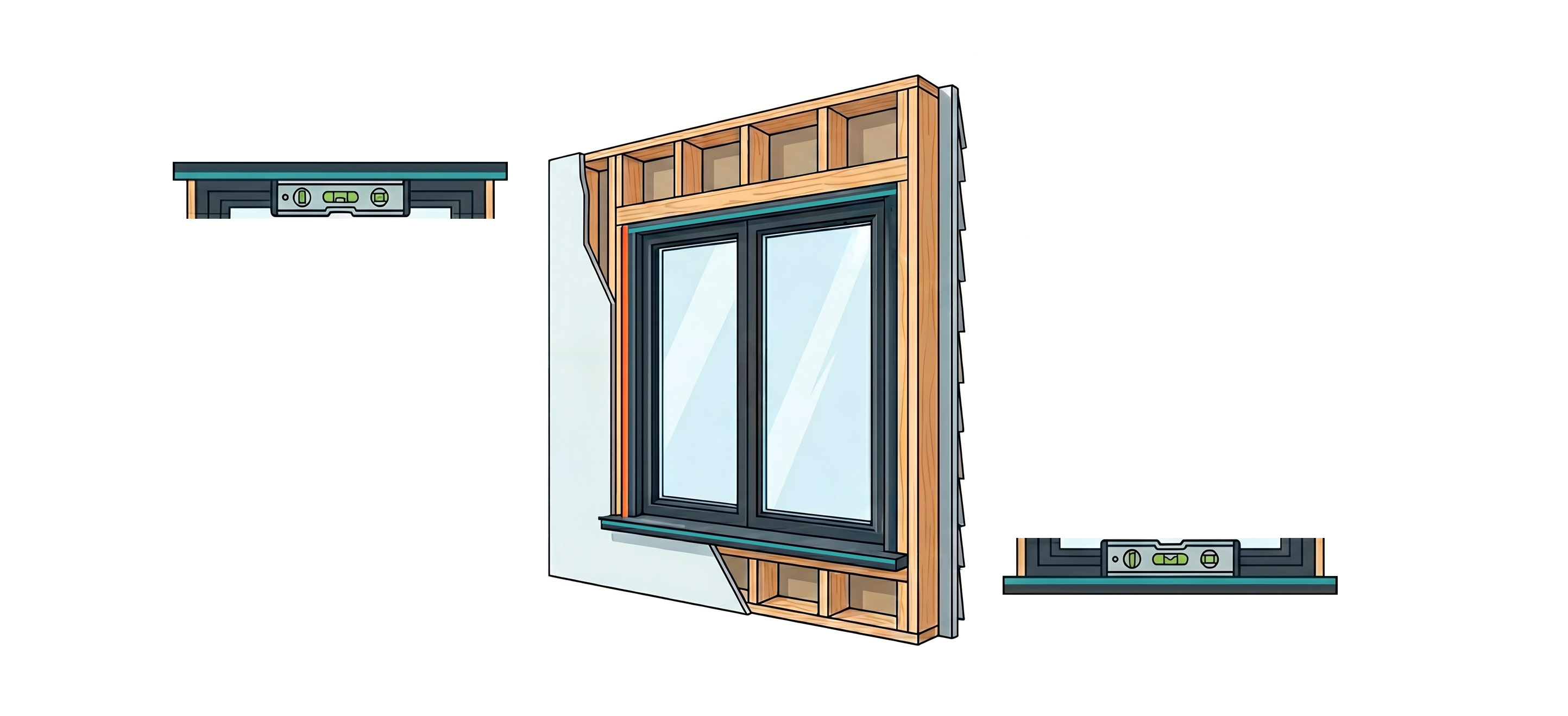
1. Level (The horizontal plane)
Level refers to the horizontal axis. We ensure the head (top) and the sill (bottom) are perfectly flat. If a window sill isn't level, water can pool in the tracks instead of draining out through the weep holes, a recipe for rot in a climate as wet as ours. If that header isn’t level, you aren't just dealing with a crooked look, you’re are potentially dealing with a structural "squeeze" which can lead to jammed locks, foggy glass, and expensive energy leaks."
2. Plumb (The vertical plane)
Plumb is the vertical equivalent of level. While "level" deals with the horizontal, "plumb" ensures the unit is perfectly upright. To get this right, an installer has to check the vertical line from two different perspectives:
- Face View (Side-to-Side) This is what you see when standing directly in front of the window. If the side jambs lean to the left or right, the window sash will drag or stick because it’s fighting gravity.
- Depth View (Front-to-Back) This is how the window sits within the thickness of your wall. If the window leans toward the backyard or toward your living room, you’ll experience the "ghost door" effect, where a door or window slowly swings open or shut on its own.
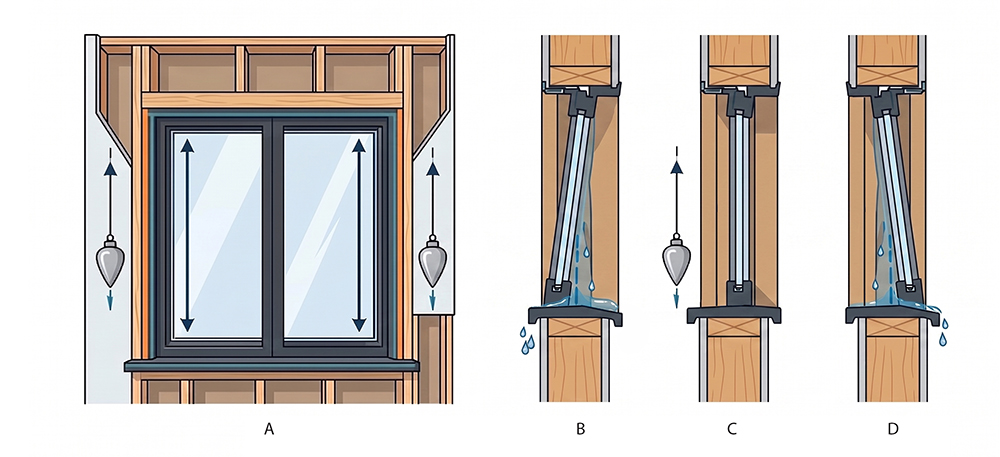
A: Straight from the front (Face Plumb).
C: Perfectly upright within the wall (Depth Plumb).
B & D: Leaning too far in or out. This causes windows to stick, locks to jam, and, most dangerously, forces water into your home’s frame instead of draining outside, leading to hidden rot and mould.
Why it matters in Ottawa If the Depth View isn't plumb, your window's drainage system can fail. Rain and melting snow need to flow out toward the exterior; if the window leans inward, that moisture can be pulled toward your home's wooden frame instead.
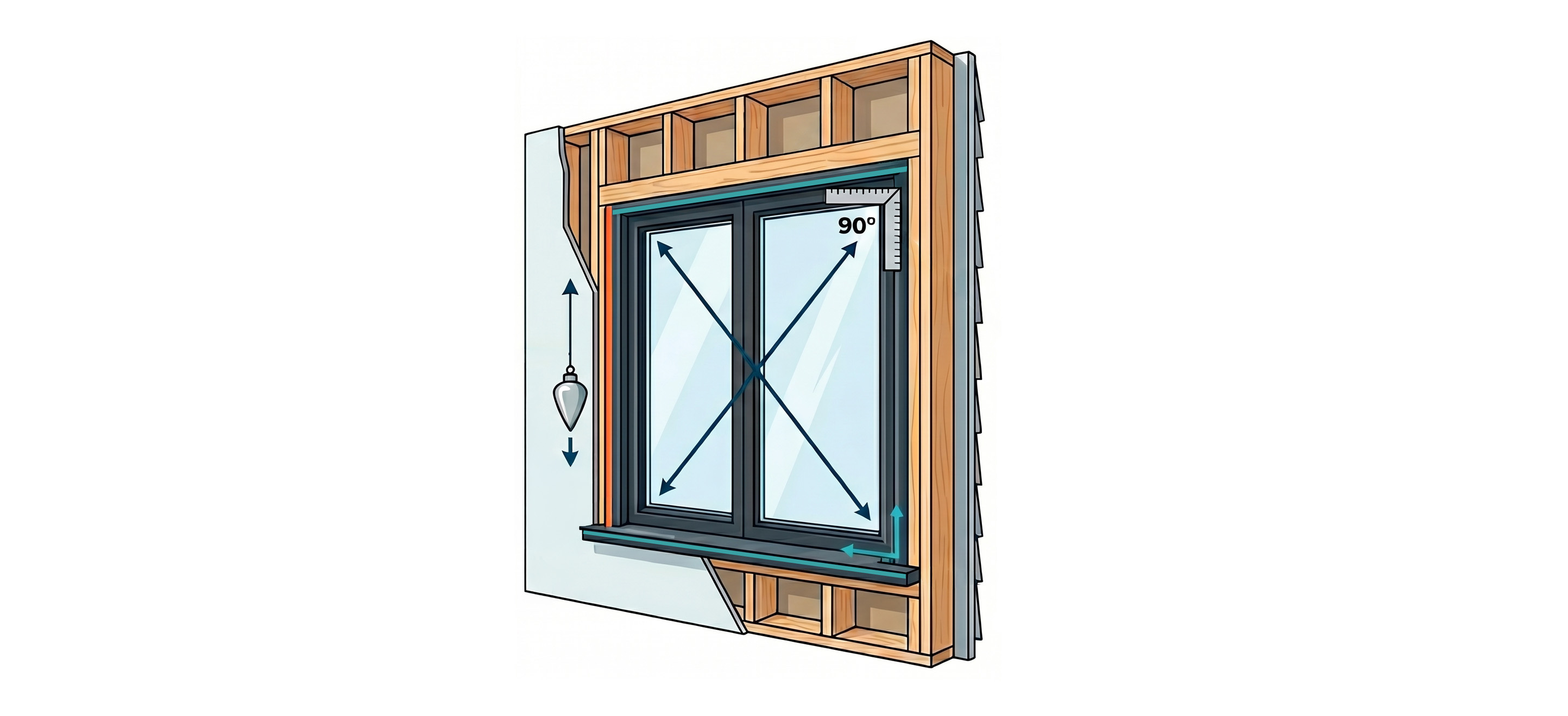
3. True (the square & straight)
A unit is "True" when it is perfectly square (all corners at 90 degrees) and not twisted. If a frame is "cross-cambered" (twisted), the sash won't sit flush against the weatherstripping, leaving a gap for Ottawa’s winter winds to whistle through.
What happens when it’s done wrong?
Improper installation doesn't always show up on day one. It’s a "slow-burn" problem that causes significant issues down the road:
Operation frustration
As the house settles and the seasons change, a window that wasn't installed "True" will start to stick. You shouldn't have to be a weightlifter to open your kitchen window for some fresh air.
Failed Seals & Foggy Glass
Ottawa’s extreme temperature swings cause materials to expand and contract. If a window is forced into a frame that isn't square, that stress eventually snaps the insulated glass seal, leading to that unsightly permanent fog between the panes.
The "micro-draft"
You might have the best R-value glass on the market, but if the frame is twisted, your expensive heated air is leaking right out of the gaps.
Structural rot
This is the most dangerous consequence. When units aren't level and true, water can bypass the flashing and seep into your wall cavity. By the time you see the mould or bubbling drywall, the damage to your home’s "bones" is already done.
Why shims matter
If Level, Plumb, and True are the goals, shimming is the specialised technique that gets us there. Shims are thin, tapered wedges used to bridge the gap between your new window frame and your home’s rough opening. They are the essential "adjusters" that allow our installers to make micro-calibrations, sometimes as small as a fraction of a millimetre - to ensure the unit is perfectly positioned within the wall.
In a climate like Ottawa’s, where the ground shifts and homes expand and contract with the seasons, the way a window is shimmed determines whether it will still open smoothly ten, twenty, or thirty years from now.
The Bayview approach: precision placement
At Bayview Windows, we believe that the quality of an installation isn't just about the tools, it’s about the strategic placement of every support point. We don't just "fill the gaps." We follow a rigorous protocol to ensure long-term performance:
Load-bearing support
We place shims at every critical fastener point and directly behind the hinges of every door. This provides a solid, stable backing that prevents the frame from "bowing" or "twisting" when the house naturally settles.
Balanced spacing for a weather-tight seal
By using shims to create a perfectly uniform "reveal" (the space between the window sash and the frame), we ensure that the weatherstripping compresses evenly. This is what keeps those biting Ottawa winds outside where they belong.
Stability for the long haul
Proper shimming ensures that the weight of the window is distributed evenly across the structural header. This prevents stress on the glass units and protects the integrity of the seals, even during our intense freeze-thaw cycles.
By taking the extra time to shim to a professional standard, we ensure your windows remain "True" for the life of the product. It’s a level of detail you might not see once the trim is on, but it’s one you will certainly feel every time you effortlessly slide your window open.
Related articles





The Bayview Difference: Quality Over Speed
In Ottawa, many retailers hire third-party subcontractors who are paid by the "window opening", the faster they finish, the more they make. This often leads to skipped steps in the installation process.
At Bayview Windows, our installers are hourly-paid employees. They don't rush. They take the time to shim, measure, and re-measure until the unit is perfectly Level, Plumb, and True. We believe so strongly in this precision that we back every installation with our Lifetime Labour Warranty.
Is your current window sticking or feeling drafty? It might not be the window itself; it might be the install.
Contact us today for a free in-home consultation, and let’s make sure your home is ready for whatever the Ottawa weather throws at it next.

Categories:

Category Posts:
A Step-by-Step Guide